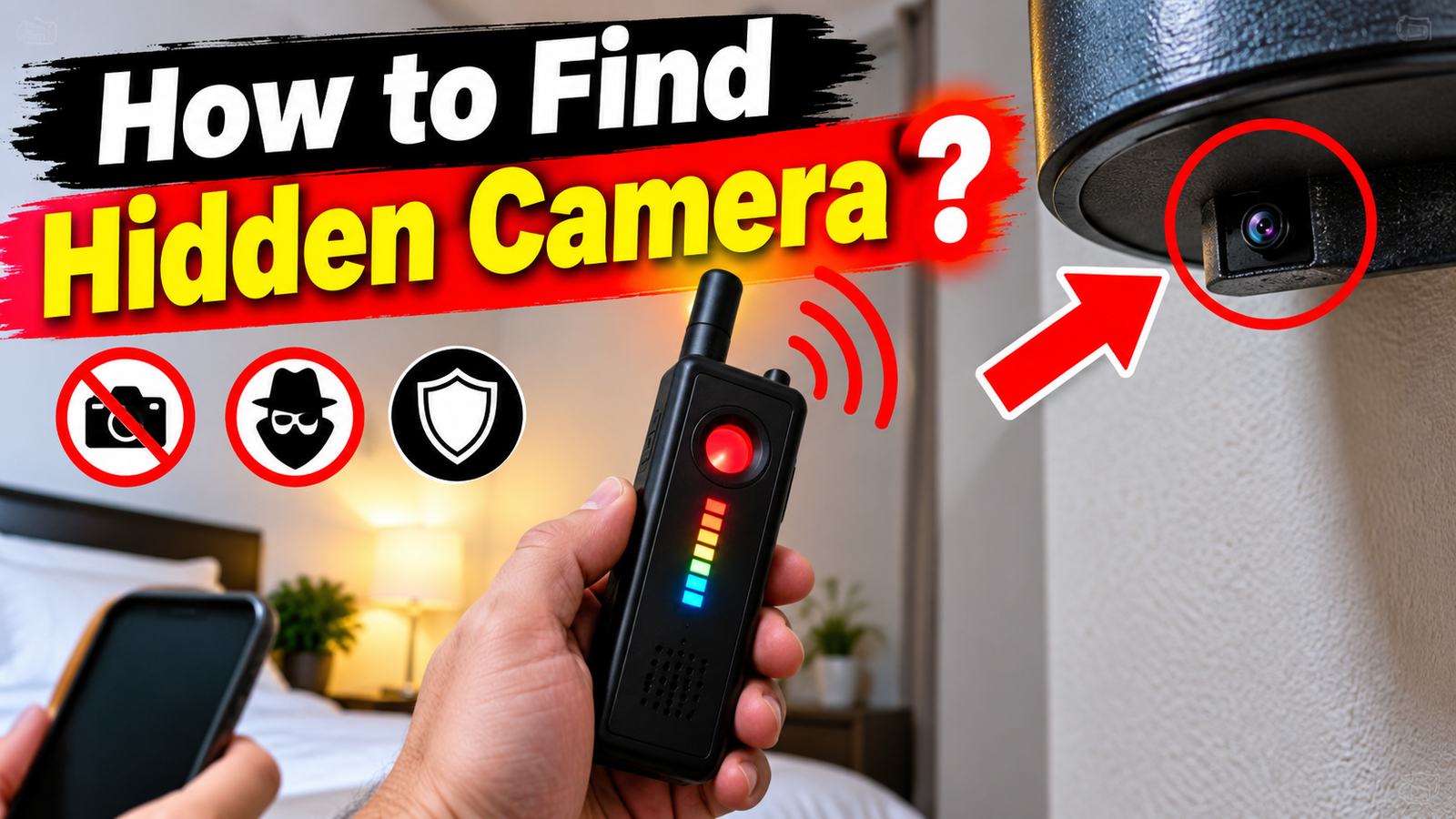

How to Find Hidden Camera? A Complete Guide to Detecting Hidden Cameras
Have you ever wondered whether a hidden camera could be recording you in a hotel room, rental apartment, changing room, or unfamiliar place? Protecting your privacy is important, and knowing how to find a hidden camera can help you feel safer and more confident.
Hidden cameras can be disguised as everyday objects, including clocks, smoke detectors, chargers, and decorative items. Although some are difficult to spot, you can use several practical techniques to identify suspicious devices without expensive equipment. This guide explains how to detect hidden cameras, use your smartphone effectively, and take the right steps if you discover something suspicious.
Why Is It Important to Find Hidden Cameras?
Hidden cameras can violate personal privacy when installed in private spaces without consent. They may be used in places such as bedrooms, bathrooms, changing areas, and private accommodation.
Learning how to detect hidden cameras is useful for travelers, renters, families, and anyone concerned about personal security. However, remember that an unusual object does not automatically mean a camera is present. Always investigate carefully before drawing conclusions.
1. Carefully Inspect the Room
The easiest way to find a hidden camera is to start with a detailed visual inspection. Many cameras require a clear view of the area they are monitoring.
Check Common Hiding Places
Pay particular attention to objects that face beds, bathrooms, changing areas, or other private spaces.
Look closely at:
- Wall clocks and digital alarm clocks
- Smoke detectors and unusual ceiling fixtures
- USB chargers, power adapters, and extension sockets
- Lamps, picture frames, and decorative objects
- Shelves, air vents, and electronic devices
- Objects with unexplained holes or small glass-like lenses
Practical tip: Look for objects that seem oddly positioned, recently installed, or unnecessarily directed toward private areas. Do not dismantle electrical equipment or smoke detectors, as doing so can create safety hazards.
2. Use Your Smartphone to Detect Hidden Cameras
Your smartphone can help you investigate suspicious objects, although it cannot reliably detect every type of camera.
Look for Lens Reflections
Some camera lenses reflect light differently from surrounding materials.
- Dim the room lights if it is safe to do so.
- Use a flashlight to slowly scan suspicious objects.
- Look for small, distinct reflections that resemble a glass lens.
- Examine unusual reflections from another angle.
Keep in mind that screws, glass, and shiny surfaces can also reflect light. A reflection alone is not proof of a hidden camera.
Check Your Phone’s Camera for Infrared Light
Some night-vision cameras use infrared LEDs. Certain smartphone cameras can detect some infrared light, especially through the front-facing camera, but many phones filter it out.
To try this method, test your phone’s camera with a known infrared remote control first. Then scan suspicious areas in a darkened room. If your phone cannot see the remote’s infrared light, this method may not work for you.
Important: Not all hidden cameras use infrared, and many legitimate infrared devices may produce similar light.
3. Check the Wi-Fi Network for Unknown Devices
Some hidden cameras transmit video over Wi-Fi, so checking the local network may provide useful clues.
How to Check Connected Devices
- Open your router’s administration page or official mobile app.
- Review the list of connected devices.
- Look for unfamiliar devices, especially those you cannot identify after checking their names and manufacturers.
- If appropriate, ask the property owner or network administrator to explain unfamiliar equipment.
Network-scanning apps may also show devices connected to the same network.
However, this method has limitations. A camera may use a separate network, record onto a memory card, or operate without internet access. Likewise, an unknown device on a network is not necessarily a camera.
4. Consider a Dedicated Hidden Camera Detector
If you need additional reassurance, a dedicated detector may help.
Common options include:
- RF detectors: Identify certain radio-frequency transmissions from active wireless devices.
- Optical lens detectors: Use light and viewing filters to help reveal camera lenses.
- Professional inspection equipment: May help locate devices that ordinary visual checks miss.
Before purchasing a detector, check its specifications and limitations. RF detectors may respond to phones, routers, and other electronics, while inactive or wired cameras may escape detection. No consumer device guarantees that every hidden camera will be found.
5. What Should You Do If You Find a Suspicious Camera?
If you discover an object that genuinely appears to be a hidden camera, prioritize your safety and privacy.
- Move to a safer location if you feel uncomfortable or believe you are being recorded in a private space.
- Document what you see by taking photographs of the object and its surroundings, if safe and lawful.
- Avoid tampering with the device. Do not destroy it, remove it, or attempt to access its recordings.
- Report the incident to the property manager, accommodation provider, platform, or relevant local authorities, as appropriate.
- Seek help promptly if you suspect illegal surveillance or face an immediate safety risk.
Avoid publicly accusing someone before the facts are established. Preserve any evidence and allow the appropriate authorities to investigate.
6. Common Myths About Finding Hidden Cameras
Several popular detection methods are less reliable than they may seem.
- Turning off the lights: Darkness can help you notice some infrared LEDs or lens reflections, but it will not reveal every camera.
- Using a phone app: Apps cannot magically detect all hidden cameras. Their effectiveness depends on the phone, the camera, and the detection method.
- Scanning Wi-Fi: Not every camera connects to the network you can access.
- Assuming every unusual object is suspicious: Many everyday devices contain small lenses, sensors, or reflective components for legitimate reasons.
The best approach combines visual inspection with other methods rather than relying on a single trick.
Conclusion
Knowing how to find a hidden camera starts with careful observation, checking suspicious objects, and understanding the strengths and limitations of smartphone tools, Wi-Fi checks, and dedicated detectors.
If you are staying in a hotel or rental property, take a few minutes to inspect the room and trust reasonable concerns without jumping to conclusions. If you discover a potentially illegal recording device, document it safely and report it to the appropriate authorities.
Your privacy matters. A calm, systematic inspection is one of the most practical steps you can take to protect it.